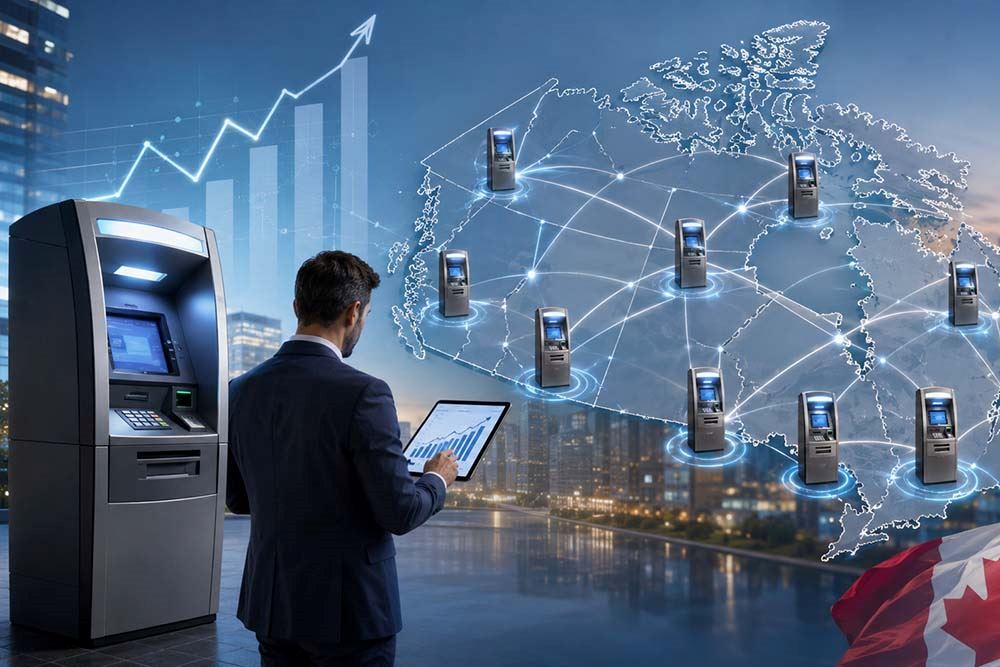
Many entrepreneurs begin with a single ATM as a way to generate supplemental income, but the real growth potential comes from building a larger portfolio. As demand for convenient cash access continues across many sectors, opportunities remain available for business owners willing to expand strategically. Understanding how to scale the ATM business in Canada in 2026 can help transform a single machine into a profitable network that generates consistent revenue. Success requires careful planning, strong location selection, reliable cash management, and a long-term growth strategy.
Starting with a Strong Foundation
Before attempting to grow the ATM business in Canada, it is important to ensure your first machine is performing consistently. Monitor transaction volumes, operating costs, maintenance expenses, cash replenishment schedules, and surcharge revenue. Understanding the performance of your initial location provides valuable insights for future expansion.
A successful first ATM demonstrates proof of concept and helps identify the types of locations that generate the highest transaction activity. The lessons learned from managing one machine often become the foundation for scaling a larger portfolio.
When to Add Additional Machines
Many operators begin considering ATM portfolio expansion in Canada in 2026 once their initial machine consistently produces reliable monthly revenue. Rather than expanding too quickly, focus on adding machines gradually to maintain operational control and financial stability.
Each new machine should be evaluated based on foot traffic, nearby competition, customer demographics, business hours, security, and projected transaction volume. Strategic growth often produces better results than rapidly acquiring multiple locations without proper analysis.
A measured approach to ATM portfolio expansion, Canada 2026, helps reduce risk while improving long-term profitability.
Building Multiple Streams of Passive Income
One of the primary reasons entrepreneurs grow ATM business Canada operations is the opportunity to create recurring income from multiple locations. Each ATM generates revenue independently, allowing operators to diversify income across several sites rather than relying on a single machine.
Over time, multiple ATM machines passive income Canada can create greater financial stability because revenue is spread across different businesses and customer bases. If one location experiences temporary declines in transactions, other machines may continue producing consistent income.
Diversification is often one of the most effective ways to strengthen the overall performance of an ATM portfolio.
Financing Your Expansion
Expanding from one machine to several often requires additional capital. Entrepreneurs pursuing ATM portfolio expansion in Canada in 2026 may use personal savings, business profits, equipment financing, small business loans, lines of credit, or partnership arrangements to fund growth.
Reinvesting revenue generated by existing machines is a common strategy because it allows operators to expand while minimizing debt. Before securing financing, carefully evaluate projected revenue, operating costs, maintenance expenses, cash requirements, and expected return on investment.
A well-planned financing strategy supports sustainable growth while preserving cash flow.
Finding New ATM Locations
Location selection remains one of the most important factors when attempting to scale the ATM business in Canada in 2026. High-traffic businesses often provide the best opportunities for long-term success. Convenience stores, restaurants, bars, entertainment venues, hotels, shopping centres, gas stations, and specialty retailers are commonly targeted by ATM operators.
Business owners seeking multiple ATM machines passive income Canada should focus on building relationships with local merchants and demonstrating the value an ATM can provide to their customers. Offering professional service, reliable maintenance, and competitive placement agreements helps secure desirable locations.
Regularly evaluating emerging neighbourhoods and growing commercial areas can also reveal new placement opportunities.
Managing a Growing Portfolio
As the number of machines increases, efficient operations become increasingly important. Operators should implement systems for cash management, maintenance scheduling, transaction monitoring, compliance reporting, and customer support.
Technology can simplify many administrative tasks, allowing owners to manage larger portfolios without significantly increasing workload. Consistent performance monitoring helps identify underperforming locations and opportunities for further growth.
A scalable operational framework is essential for long-term success in the ATM industry.
FAQ’s
Q1. How do I scale my ATM business beyond one machine in Canada?
A: To scale the ATM business in Canada by 2026, start by optimizing the performance of your first machine, reinvest profits, identify high-traffic locations, secure additional placements strategically, and develop systems for managing multiple machines efficiently.
Q2. At what point does an ATM business become a full-time income in Canada?
A: There is no fixed number of machines required. Income depends on transaction volume, surcharge rates, operating costs, and location quality. Many operators find that as they grow ATM business in Canada portfolios and add profitable locations, income becomes increasingly substantial and predictable.
Q3. What financing options help expand an ATM portfolio?
A: Common financing options for ATM portfolio expansion in Canada 2026 include business savings, reinvested ATM profits, equipment financing programs, small business loans, lines of credit, and investment partnerships. The most suitable option depends on your financial situation and growth objectives.
Q4. How do I find new ATM placement locations as I grow my business?
A: Building relationships with local businesses is often the most effective strategy. Entrepreneurs pursuing multiple ATM machines passive income Canada should target high-traffic locations such as convenience stores, restaurants, entertainment venues, hotels, shopping centres, and service businesses where customers frequently require access to cash.