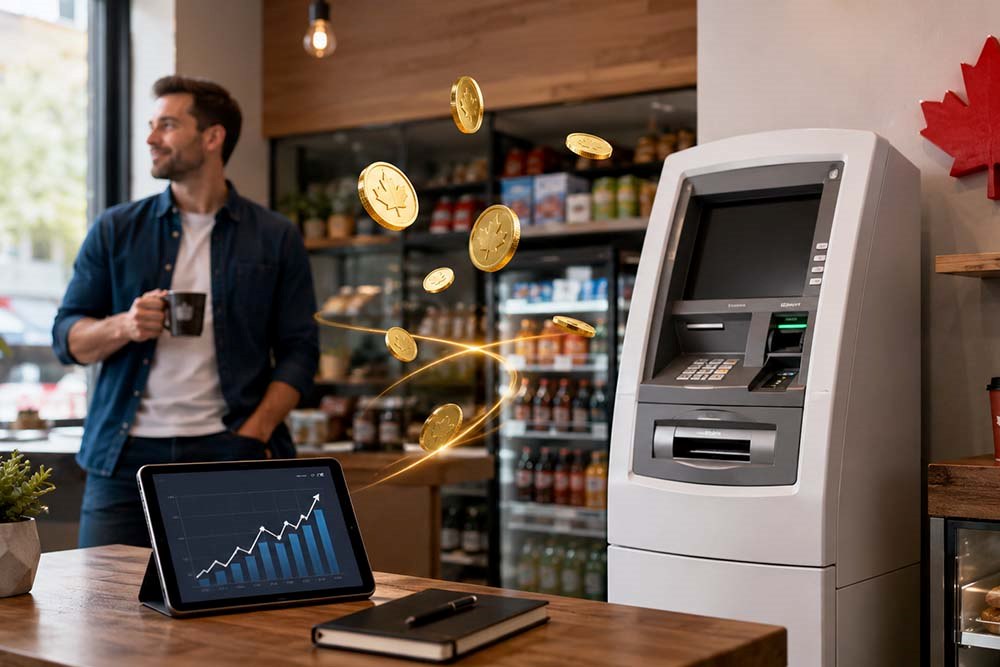
The ATM business is often marketed as a “set it and forget it” passive income model in Canada. In reality, it can be semi-passive at best, with income depending heavily on location quality, cash usage trends, fees, and maintenance structure.
In 2026, ATM ownership in Canada is still viable, but margins are tighter, and performance is more sensitive to placement and foot traffic than most people expect.
How Much Passive Income Does an ATM Business Generate in Canada?
ATM income is primarily driven by surcharge fees per withdrawal and transaction volume.
Typical ATM revenue per machine (Canada 2026 estimates):
Low-performing location
- 100–200 transactions/month
- $2.00–$3.00 surcharge average
- $200 – $600/month gross revenue
Average location (typical retail site)
- 300–600 transactions/month
- Moderate foot traffic (convenience stores, small plazas)
- $600 – $1,500/month gross revenue
High-performing location
- 800–1,500+ transactions/month
- High foot traffic (bars, festivals, tourist zones)
- $1,500 – $3,500+/month gross revenue
Important reality check:
These numbers are gross revenue, not profit.
After expenses, real passive income is significantly lower.
Is an ATM Business Truly Passive or Does It Need Active Management?
The ATM business is best described as semi-passive income with operational upkeep.
Tasks that require ongoing management:
- Cash loading (or coordination with cash services)
- Machine maintenance and repairs
- Monitoring transaction performance
- Security and cash risk management
- Contract negotiation with location owners
More passive setups exist if you:
- Use armored cash replenishment services
- Partner with full-service ATM processors
- Place machines in stable, high-traffic locations
Key insight: The more you outsource, the more passive it becomes—but margins shrink.
How Long Does It Take to Recoup Your ATM Business Investment in Canada?
Initial investment typically includes:
- ATM purchase
- Installation setup
- Initial cash float
- Processing setup fees
Typical startup cost:
$3,000 – $8,000 per machine (basic setup range)
Payback period scenarios:
Strong location:
- Net profit: $500 – $1,500/month
- Payback: 6–12 months
Average location:
- Net profit: $200 – $700/month
- Payback: 12–24 months
Weak location:
- Low traffic or poor placement
- Payback: 24+ months or negative ROI
Key insight: The ATM business is location-dependent more than capital-dependent.
What Are the Real Expenses of Running an ATM Business in Canada?
Many new operators underestimate ongoing costs.
1. Transaction processing fees
- Per-transaction charges to the processor
- Network switching fees
Can reduce profit by 10–30% of revenue
2. Cash replenishment costs
- Cash float required (money sitting in the machine)
- Bank withdrawal or funding costs
- Armored transport fees (if outsourced)
3. Machine maintenance
- Repair costs for card reader or printer issues
- Software updates
- Hardware replacement over time
4. Location fees (revenue share)
Many merchants demand:
- 10% – 30% of surcharge revenue
or fixed monthly rent
5. Insurance and fraud protection
- Cash theft coverage
- Liability insurance depends on the location
ATM Business Profit Reality in 2026
Typical net profit breakdown:
| Location quality | Gross/month | Net/month (after expenses) |
| Low traffic | $200–$600 | $50–$300 |
| Average retail | $600–$1,500 | $300–$900 |
| High traffic | $1,500–$3,500 | $900–$2,500+ |
Key Factors That Determine Success
1. Location quality (most important)
- Bars, convenience stores, casinos, transit hubs
- High impulse cash demand areas
2. Surcharge pricing strategy
- Too high → fewer withdrawals
- Too low → weak margins
3. Foot traffic consistency
Seasonal or event-driven locations can spike income significantly.
4. Operational efficiency
- Reliable cash loading system
- Minimal downtime
- Strong maintenance response time
Common Misconceptions About ATM Passive Income
“It runs itself completely”
Reality: Requires monitoring and cash management.
“Any location will work”
Reality: Poor locations often lose money after fees.
“High profit with no risk”
Reality: Cash handling, theft risk, and machine downtime exist.
Is the ATM Business Still Worth It in 2026?
Yes—but only under the right conditions:
Good fit if:
- You can secure high-traffic retail locations
- You understand cash flow and logistics
- You are willing to optimize placement and contracts
Poor fit if:
- You expect a fully passive income
- You choose locations based only on availability
- You ignore transaction analytics
Conclusion
The ATM business in Canada in 2026 can generate steady income, but it is not truly passive in its early stages. Real returns depend heavily on placement quality, fee structure, and operational efficiency. High-performing machines can deliver solid monthly cash flow, but weak locations can barely break even after expenses.
Success comes from treating ATM ownership like a micro real estate investment, not a passive income shortcut.
FAQ’s
Q1. How much passive income does an ATM business generate in Canada?
A: Most ATMs generate between $300 and $2,500+ per month in net profit, depending on location quality and transaction volume.
Q2. Is an ATM business truly passive, or does it need active management?
A: It is semi-passive. It requires cash loading, maintenance oversight, and performance monitoring unless fully outsourced.
Q3. How long does it take to recoup your ATM investment in Canada?
A: Typically 6–24 months, depending on location quality and net monthly profit.
Q4. What are the real expenses of running an ATM business in Canada?
A: Expenses include processing fees, cash handling costs, maintenance, revenue sharing with merchants, and insurance.